How to Cite
Abstract
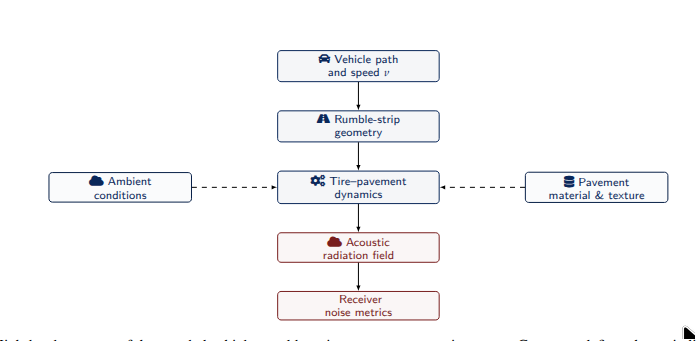
Roadside and centerline rumble strips are widely deployed to mitigate run-off-road and crossover crashes by introducing tactile vibration and audible cues when tires traverse a patterned surface. The same mechanism that improves safety can also generate exterior noise that is perceived as intrusive by nearby communities, particularly where roadways pass through noise-sensitive land uses. This paper examines how rumble-strip geometry and pavement-related attributes jointly govern noise generation and its spectral characteristics, emphasizing a parametric viewpoint that can support design tradeoffs. A coupled framework is described that links tire excitation over periodic surface features to structural response in the tire--pavement system and to radiated sound quantified at a receiver through standard acoustic metrics. Geometric drivers include groove depth, width, spacing, profile shape, shoulder offset, and the spatial regularity of patterns, while pavement drivers include macrotexture, porosity, viscoelastic stiffness, surface temperature state, and construction variability. The analysis highlights that seemingly small geometric adjustments can shift dominant excitation frequencies into bands with higher human sensitivity, while pavement properties can amplify or damp specific bands through impedance, hysteretic losses, and air pumping pathways. A statistical modeling layer is used to separate systematic effects from nuisance variability associated with vehicle speed, tire type, and ambient conditions. The results motivate geometry--pavement co-optimization rather than geometry-only adjustments, and they clarify which parameters most reliably reduce A-weighted levels without eroding in-vehicle alerting performance.